
Bringing home a Groodle puppy is exciting — but one of the most common questions new owners ask is:
“What size crate should I buy?”
Choosing the right crate size is important not only for comfort, but also for successful toilet training, sleep routines, safety, and helping your puppy feel secure in their new home.
At Fairview Park Groodles, we often recommend crate training because, when introduced positively, crates become a safe and calming “den” space for your puppy.
Why Crate Size Matters
A crate should never feel cramped or restrictive — but it also shouldn’t be oversized.
Research and training recommendations consistently suggest that a dog’s crate should allow them to:
- Stand comfortably without crouching
- Turn around easily
- Stretch out and lie down naturally
- Sit upright comfortably
- Feel secure and settled
Animal welfare guidelines and veterinary behaviour recommendations also emphasise that dogs should have enough room to stand, stretch, and turn freely.
A crate that is too small can cause discomfort and stress, while a crate that is too large can make toilet training more difficult, as puppies may use one end as a sleeping area and the other as a toilet area.
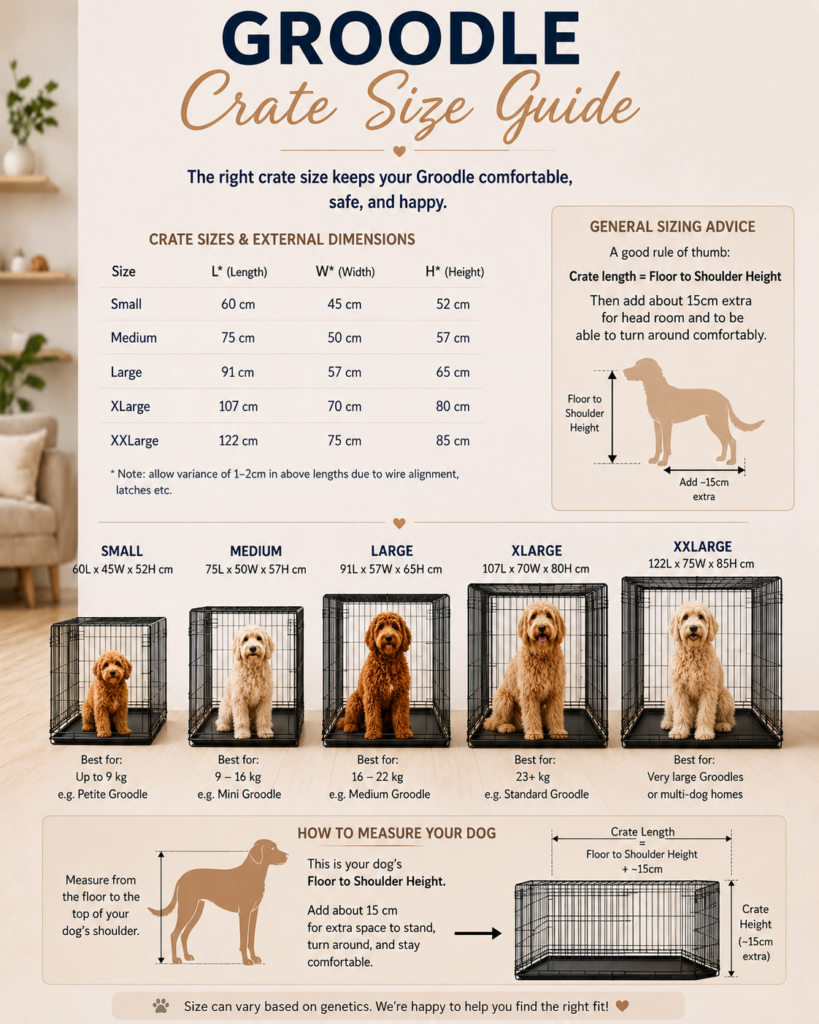
How to Measure Your Dog for a Crate
A good general rule is:
Crate Length = Floor to Shoulder Height + approximately 15cm
The extra space allows room for:
- head height
- comfortable turning
- stretching
- natural movement
Many trainers and crate manufacturers also recommend adding approximately 5–10cm (2–4 inches) extra to your dog’s measurements for comfort.
To measure your Groodle:
- Measure from the floor to the top of the shoulder while standing
- Measure body length from nose to base of tail
- Add extra room for movement and comfort
Remember that coat fluff can also make Groodles appear bigger in crates than smooth-coated breeds!
Recommended Crate Sizes for Groodles
Because Groodles come in a range of sizes, crate recommendations vary depending on the expected adult size of your puppy.
Petite Groodles (Approx. 4–9kg | 23–33cm tall)
Recommended crate:
- Small crate
- Approx. 60L x 45W x 52H cm
These are generally suitable for petite or toy-sized Groodles.
Mini Groodles (Approx. 9–16kg | 36–43cm tall)
Recommended crate:
- Medium crate
- Approx. 75L x 50W x 57H cm
This is one of the most common sizes for mini Groodles and often works well into adulthood.
Medium Groodles (Approx. 16–22kg | 46–53cm tall)
Recommended crate:
- Large crate
- Approx. 91L x 57W x 65H cm
Most medium Groodles are most comfortable in a large crate with enough room to stretch and settle.
Standard Groodles (Approx. 23kg+ | 56–63cm tall)
Recommended crate:
- XLarge or XXLarge crate
- Approx. 107–122cm long
Standard Groodles are tall dogs and benefit from extra height and turning space.
Should You Buy an Adult-Sized Crate for a Puppy?
Usually, yes.
Most owners purchase the crate size their puppy will ultimately need as an adult and simply make the space smaller temporarily while toilet training.
You can do this by:
- using a crate divider
- placing a sturdy box at one end
- reducing excess space with bedding
This avoids needing to buy multiple crates as your puppy grows.
Wire vs Plastic Crates
Both options can work well, depending on your puppy and lifestyle.
Wire Crates
Pros:
- excellent airflow
- more visibility
- foldable and versatile
- great for home use
Cons:
- less “den-like” for some anxious puppies
Plastic Crates
Pros:
- cosy and enclosed
- often preferred for travel
- can feel safer for nervous puppies
Cons:
- heavier
- less ventilation
Many Groodle owners find wire crates with a partial cover work beautifully, creating a calm den-like feeling while maintaining airflow.
Making the Crate a Positive Space
The crate should always feel safe and positive — never like punishment.
We recommend:
- feeding meals in the crate
- offering safe chew toys
- using soft bedding
- keeping the crate near family initially
- rewarding calm crate behaviour
The RSPCA also recommends introducing crates gradually and positively to help puppies build confidence and security.
Common Crate Sizing Mistakes
Choosing a crate that is too small
Your dog should never have to crouch or squeeze into the crate.
Choosing a crate that is excessively large
Oversized crates can slow toilet training and reduce the secure “den” feeling.
Forgetting future growth
Groodle puppies grow quickly — especially during the first 6–12 months.
Using the crate as punishment
The crate should always remain a calm and positive environment.
Final Thoughts
Every Groodle is slightly different depending on genetics, build, coat, and temperament. Some are taller and leaner, while others are stockier or fluffier.
As a general guide:
- Mini Groodles usually suit medium crates
- Medium Groodles often suit large crates
- Standard Groodles typically need XL or XXL crates
If you are ever unsure, we are always happy to help guide Fairview Park families toward the right fit for their puppy.
A properly sized crate can make a huge difference in helping your puppy feel safe, secure, and settled during those important early weeks at home.